
Imagine borrowing $300 to get through an emergency. Over the next year, you pay $679.90 in interest and broker fees. You still owe the $300 you originally borrowed.
The lender’s stated annual interest rate? Ten percent.
That hypothetical illustrates the problem with Texas’s payday-loan broker model. The lender charges interest. A separate business charges a fee for arranging the loan. Both charges come out of the borrower’s pocket.
What the payments actually buy
Suppose the loan lasts fourteen days. On $300, interest at 10% annually comes to $1.15 for that period, using a 365-day year and rounding to cents. Add a hypothetical $25 broker fee, and the borrowing charge is $26.15.
Now suppose the borrower cannot repay the principal and repeatedly renews or replaces the loan on the same terms. Each two-week period brings another $26.15 charge, without reducing the $300 balance.
Over 26 periods—364 days—the charges total $679.90: $29.90 in interest and $650 in broker fees. The original $300 remains unpaid.
The borrower has paid more than twice the amount borrowed. Those payments bought time, but no progress toward eliminating the debt.
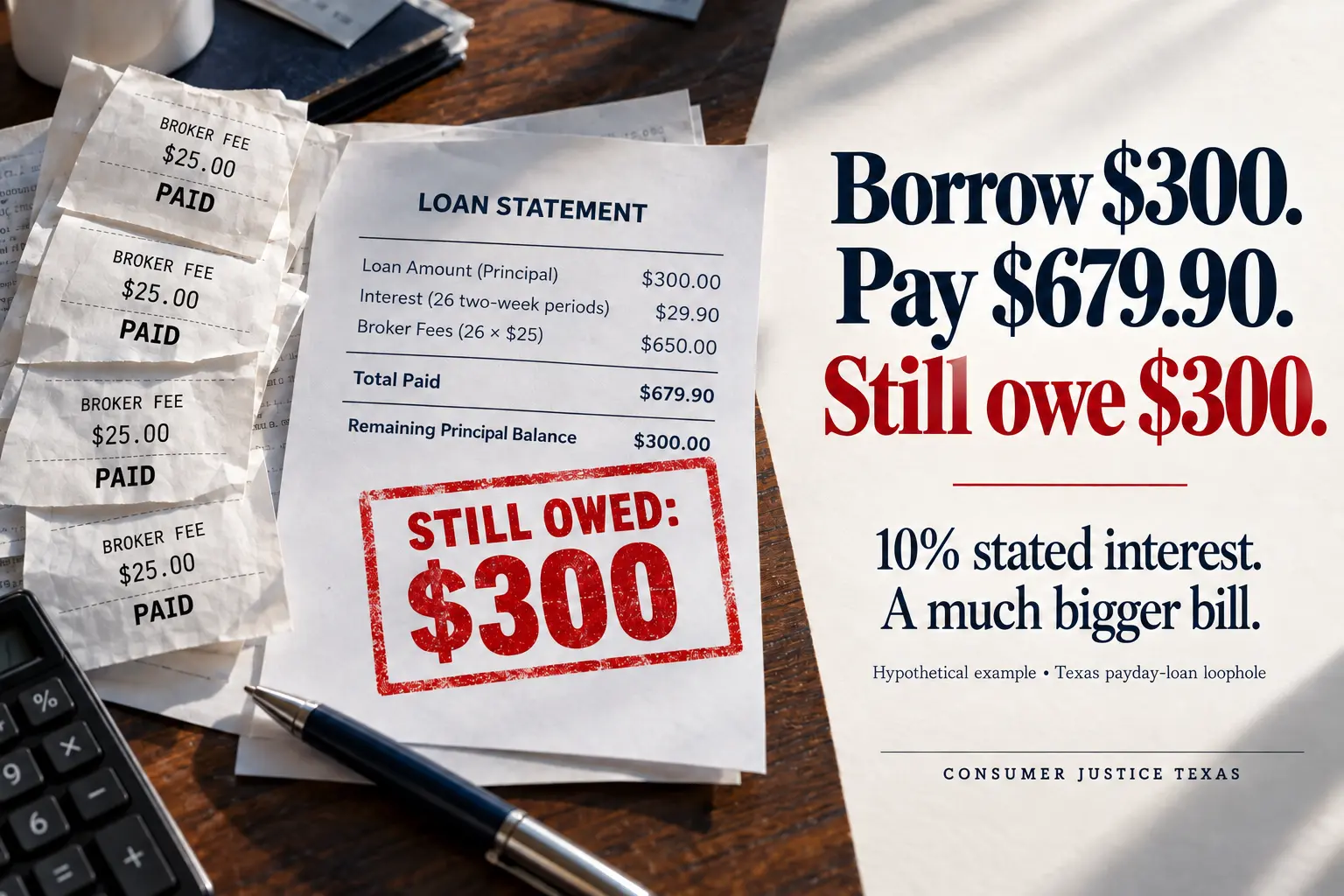
An illustration, not a typical-loan claim
This is a calculation, not a reported borrower’s story or a claim that every loan works this way. It assumes a fresh $25 broker charge each period, unchanged principal, and no additional charges. Actual contracts, payments, and applicable restrictions matter.
The $679.90 equals about 227% of the original principal over 364 days. That comparison is separate from the lender’s stated rate and should not be confused with a calculation of a particular contract’s disclosed APR.
The price that matters
For someone trying to keep the electricity on or pay for an emergency repair, the distinction between interest and a broker fee offers little comfort. Both make the loan more expensive.
A borrower needs to know more than the stated interest rate: How much must I pay? How much reduces the balance? What happens if I need more time?
In my view, a credit system should offer a workable route out of debt. Paying repeatedly while the balance stands still should make us question whether the protection promised by interest limits is reaching the person who needs it.
Next: One Loan. Two Contracts. The Texas Payday Loophole.
 CONSUMER JUSTICE TEXAS IS A TAX-EXEMPT NONPROFIT ORGANIZATION RECOGNIZED UNDER § 501(c)(3).